
Beaver Island Music Festival was founded in 2003 by a small group of people who had a vision. Their vision was to bring talented musicians and artists to make “Music in the Woods” to the island. Due to this unique Michigan festival’s increasing growth and popularity, BIMF established itself as a non-profit 501(c)(3) organization in 2013.
In 2018 to expand the Beaver Island Music Festival Inc. mission, our group of dedicated board members agreed that changing the name of the overseeing organization to Patrons of the Arts in Rural Communities would be the first step in creating that broader vision for the future of BIMF.
Beaver Island Music Festival promotes the variety and tradition of all music and art. We want to create opportunities for all artists, be an educational resource, and strongly encourage community and family involvement in an outdoor environment combining nature, renewable energies, music, and artwork. Our main goal is to bring attention to the beautiful world we live in (especially Beaver Island) by uniting these talents and people.
BIMF History – 2025
The Seed Is Planted (2003)
The story of the Beaver Island Music Festival (BIMF) begins not with a business plan, but with a spontaneous act of joy. In the summer of 2003, a small group of friends orchestrated an impromptu concert deep in the island’s woods to host musician Stephen Garcia and his band, Simplicity. With a stage cobbled together on a flatbed trailer, power sourced from a generator, and a bonfire casting light on the gathering, music flowed through the pine-scented air. This “casual plot” drew an unexpected crowd of 40 visitors who camped for the weekend and 75 islanders who found their way to the clearing. The resounding success of that magical, off-grid night revealed a profound community desire for a shared musical experience in nature, planting the seed for what would become an annual tradition…
















Updated 2022
1.1. Name. The name of the Corporation is Patrons of the Arts in Rural Communities.
1.2. Places of Business. The Corporation shall have its principal place of business in Beaver Island, Michigan, and may have such other places of business as the Board of Directors may determine from time to time.
1.3. Purpose.
As outlined in its Articles of Incorporation, the purpose of the Corporation is to promote music and art in Beaver Island and the surrounding communities by creating opportunities for artists, being an educational resource, and encouraging community and family involvement.
1.4.
The Corporation shall be operated exclusively for purposes within the meaning of Section 501(c)(3) of the Internal Revenue Code of 1986 (the “Code”), or comparable provisions of subsequent legislation, as a Michigan Nonprofit Corporation. No Director, Officer, or another member of the Corporation shall have any title to or interest in the corporate property or earnings in their individual or private capacity, and no part of the net earnings of the Corporation shall inure to the benefit of any Director, Officer, or another private individual. No substantial part of the Corporation’s activities shall consist of carrying on propaganda or otherwise attempting to influence legislation, nor shall the Corporation participate or intervene in any political campaign on behalf of or in opposition to any candidate for public office.
2.1. Governing Body. The business and affairs of the Corporation shall be managed by the Board of Directors, which is the governing body of the Corporation. The Corporation is organized as a Michigan Nonprofit Corporation without members or shareholders. Except as otherwise provided by law, all matters subject to membership vote or other action in the case of a Michigan Nonprofit Membership Corporation shall be approved by action of the Board of Directors. The Board of Directors shall meet as often as necessary to conduct the business of the Corporation, but at least four (4) times per year.
2.2. Number, Selection, and Terms of Directors.
2.2.1. The Board of Directors shall consist of no less than seven (7) people and no more than twelve (12) people. The number of directors may only be changed by a resolution adopted by the affirmative vote of a majority of the directors then in office. At no time shall the Board of Directors have less than three (3) members or the minimum amount required by law.
2.2.2. Directors shall serve terms of two (2) years.
2.2.3. A director shall hold office until the annual meeting of the Board of Directors for the year in which their term expires or until the director’s resignation or removal. A director may resign by written notice to the Corporation. A director’s resignation is effective upon its receipt by the Corporation or a subsequent time outlined in the statement of resignation.
2.3. Removal. Any director may be removed from office with or without cause at any annual or special meeting of the Board of Directors by the affirmative vote of a majority of the directors then in office.
2.4. Vacancies. Vacancies occurring on the Board of Directors because of death, resignation, retirement, removal, or another inability to serve shall be filled by the affirmative vote of a majority of the remaining directors. A director elected to fill a vacancy shall serve for the unexpired portion of the term.
2.5. Annual Meeting. The annual meeting of the Board of Directors shall be held in conjunction with the regular meeting of the Board of Directors in January. At the annual meeting, the Board of Directors shall elect directors, elect officers, and consider other business that may properly be brought before the meeting.
2.6. Regular and Special Meetings. Regular meetings of the Board of Directors may be held at such times and places as the directors may from time to time determine. The Chair of the Board may call special meetings of the Board of Directors upon written notice to the other directors either personally or by sending such information to each director electronically or by mail at the address designated by the director for such purposes.
2.7. Notice of Meetings of the Board of Directors. Except when more critical notice is required by law, written notice of the time and place of all meetings of the Board of Directors shall be given to each director at least seven (7) days before the date of the meeting, either personally or by sending such notice to each director electronically or by mail at the address designated by the director for such purposes, or if none is specified, at the director’s last known address. Notice of any special meeting shall state the purpose or purposes of the forum, and no business may be conducted at a special meeting other than that specified in the notice. Notice of any meeting of the Board of Directors may be waived in writing before or after the meeting. Attendance at a meeting constitutes a waiver of notice of the meeting.
2.8. Action Without a Meeting. Any action required or permitted at any meeting of the Board of Directors or a committee appointed by the Board of Directors may be taken without an appointment, without prior notice, and without a vote if all directors or committee members are entitled to vote thereon consent in writing. For purposes of these Bylaws, e-mails shall constitute writings. Said written consents shall be filed with the minutes of the proceedings and shall have the same effect as a vote for all purposes.
2.9. Quorum and Voting Requirements. A majority of the directors then in office or a majority of any committee appointed by the Board of Directors constitutes a quorum for the transaction of business. The vote of a majority of the directors or committee members present at any meeting at which there is a quorum shall be the acts of the Board of Directors or the committee, except as a more significant vote may be required by state, federal, or local laws, these Bylaws, or the Articles of Incorporation. If less than a quorum is present at any such meeting, most of the directors or committee members current may adjourn the meeting without further notice to any absent director or committee member.
2.10. Participation in Meetings by Remote Communications Equipment. A member of the Board of Directors or a committee appointed by the Board of Directors may participate in a meeting by conference telephone or similar communications equipment. All people participating in the meeting can hear one another. Participation in a meeting in this manner constitutes presence in person at the meeting.
2.11. Powers of the Board of Directors. The Board of Directors shall have charge, control, and management of the business, property, personnel, affairs, and funds of the Corporation and shall have the power and authority to do and perform all acts and functions permitted for a corporation described in Section 501(c)(3) of the Code not inconsistent with these Bylaws, the Articles of Incorporation, the Michigan Nonprofit Corporation Act, Act 162 of 1982, or any other laws of the State of Michigan. In addition to and not in limitation of all powers, express or implied, now or hereafter conferred upon boards of directors of nonprofit Corporations, the Board of Directors shall have the ability to borrow or raise money for corporate purposes, to issue bonds, notes, or debentures, to secure such obligations by mortgage or another lien upon any of the property of the Corporation, whether at the time owned or after that acquired, and to guarantee the debt of any affiliated or subsidiary Corporation or other entity, whenever the same shall be in the best interests of the Corporation and furtherance of its purposes.
2.12. Conflicts of Interest. The Board of Directors may, from time to time by resolution, adopt policies and procedures regarding potential dual, conflicting, or incompatible interests of directors, officers and executive and administrative employees (or contract personnel) and members of the immediate families of such directors, officers, employees, and contract personnel. The policies and procedures may include a system for reporting interests of such directors, officers, employees, and contract personnel annually and every time there is a decision under consideration in which such a person may have an interest.
2.13. Compensation. Directors shall receive such reasonable compensation for their services as directors as shall be fixed from time to time by the Board of Directors. The Board of Directors shall also reimburse directors for reasonable expenses, including travel costs, actually and necessarily incurred in performing their duties on behalf of the Corporation by guidelines established by the Board of Directors from time to time.
2.14. Execution of Conveyances, Mortgages, and Contracts. The Board of Directors may designate one or more officers, agents, or employees to execute any contract, conveyance, mortgage, or another instrument on behalf of the Corporation. Such authority may be general or confined to specific transactions. The Board of Directors may also ratify any execution. When the implementation of any instrument has been authorized without specifying the executing officers or agents, the Chair of the Board or the Executive Director may execute such instrument on behalf of the Corporation.
3.1. Officers. The offices shall be a Chair of the Board, Vice-Chair of the Board, Executive Director, a Secretary, and a Treasurer. The same person may hold any two offices.
3.2. Election and Term of Office. All officers shall be elected for two (2) years (or until their successors have been selected) by the Board of Directors at its annual meeting. No person may execute, acknowledge or verify any instrument in more than one capacity if the instrument is required by law or by the Articles of Incorporation or these Bylaws to be executed, acknowledged, or verified by two (2) or more officers.
3.3. Removal. Except for the Executive Director, any officer may be removed with or without cause by the vote of a majority of the directors then in office at any regular or special meeting of the Board of Directors.
3.4. Vacancies. In the event of the death, resignation, retirement, removal, or another inability to serve any officer, the Board of Directors shall elect a successor who shall serve until the expiration of the regular term of such officer or until their successor shall be elected.
3.5. Chair of the Board. The Board of Directors shall elect from among its members a Chair of the Board who shall preside at all meetings of the Board of Directors at which they are present. In any absence or disability of the Chair, the directors shall elect one of their members to serve as Chair Pro Tem. The Chair shall be ex officio a voting member of each committee of the Board. The Chair shall see that all orders and resolutions of the Board of Directors are faithfully executed and shall perform such other duties as the Board of Directors may determine from time to time.
3.6. Vice-Chair of the Board. The Corporation may have the number of Vice-Chairs of the Board as the Board of Directors may determine from time to time, and each Vice-Chair shall have such duties as the Board of Directors shall determine.
3.7. Secretary. The Secretary shall keep the minutes of meetings of the Board of Directors and committees of the Board; see that all required notices are duly and timely given; be the custodian of the records of the Corporation, and maintain a book containing the names and addresses of the directors of the Corporation.
3.8. Treasurer. The Treasurer shall have charge of the funds of the Corporation, except for such funds as the Board of Directors may designate; shall see that an accounting system is maintained that will give a true and accurate accounting of the financial transactions of the Corporation, and shall render reports from time to time as requested by the Board of Directors of their activities and the financial condition of the Corporation. All funds received by the Treasurer shall immediately be deposited in a depository designated by the Board of Directors.
4.1. Right to Indemnification. Each individual who was or is a party or is threatened to be made a party to any threatened, pending or completed action, suit or proceeding, whether civil, criminal, administrative, or investigative and whether formal or informal (from now on a “proceeding”) because such individual is or was a director or officer of the Corporation shall be indemnified and held harmless by the Corporation to the fullest extent authorized by the Michigan Nonprofit Corporation Act and other applicable laws of the State of Michigan, as the same exists or may hereafter be amended, against reasonable expenses, judgments, penalties, fines, and amounts paid in settlement incurred by such indemnitee in connection in addition to that and such indemnification shall continue as to an indemnitee who has ceased to be a director or officer and shall inure to the benefit of such indemnitee’s heirs, executors, and administrators. However, this indemnification shall not apply if the corporation or another director has filed suit against a director or officer. The right to indemnification and the payment of expenses incurred in defending a proceeding in advance of its final disposition conferred in this Article shall not be exclusive of any other right which any person may have or hereafter acquire under any statute, provision of the articles of the Corporation, agreement or vote of disinterested directors or otherwise.
4.2. Insurance. The Corporation may purchase and maintain insurance, at its expense, to protect itself. Any person who is or was a director, officer, employee, nondirector volunteer, or agent of the Corporation against any liability asserted against the person or incurred by the person in any such capacity or arising out of the person’s status as such, whether or not the Corporation would have the power to indemnify such person against such expense, liability or loss under the Michigan Nonprofit Corporation Act or other applicable laws of the State of Michigan. Notwithstanding the preceding, the Corporation shall not pay premiums for such insurance attributable to insurance coverage matters for which the Corporation would not be authorized to indemnify the person to the extent such premiums, together with any compensation paid to such person for services (as a director, officer, employee or otherwise), exceed reasonable payment for services rendered to the Corporation.
The Board of Directors may establish committees for any such purpose that the Board decides. The Board of Directors may also establish and define the responsibilities of committees from time to time as it shall deem appropriate to conduct the activities of the Corporation. The members and chairs of all committees shall be nominated by vote of a majority of the directors then in office. The Board of Directors may designate one or more qualified individuals as alternative members of any committee who may replace any absent or disqualified member at any committee meeting.
These Bylaws may be amended by the affirmative vote of a majority of the directors then in office. No amendment that is inconsistent with Section 501(c)(3) of the Code not inconsistent with these Bylaws, the Articles of Incorporation, the Michigan Nonprofit Corporation Act, Act 162 of 1982, or any other laws of the State of Michigan shall be effective.
7.1. Should the Patrons of the Arts in Rural Communities – “Beaver Island Music Festival” dissolve, all assets and real and personal property belonging to this organization will revert to another 501(c) 3 organization
7.2. The Patrons of the Arts in Rural Communities “Beaver Island Music Festival” will remain non-profit forever.
The 2024-2025 budget report provides a comprehensive overview of the financial landscape, presenting both the strengths and areas of concern within the budgeting process. Moving forward, it will be essential to enhance revenue-generating strategies while managing expenses efficiently, and on-time revenue to ensure long-term sustainability and growth. If you need more details or specific areas to focus on in the summary, feel free to ask!
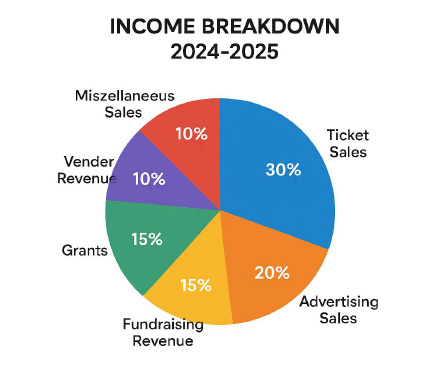 The budget report for 2024-2025 highlights the organization’s financial performance, summarizing income generated and expenses incurred throughout the year.
Income Overview:
Overall, the income reflects robust financial inflows, supported by a mix of sales, fundraising, and advertising efforts.
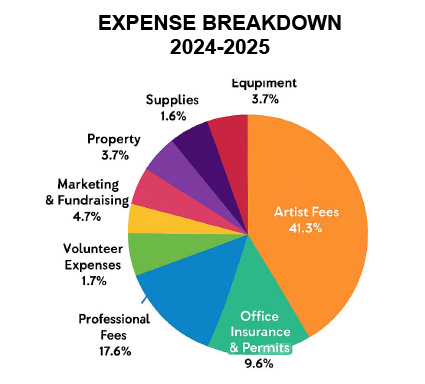 Expense Overview:
The report indicates that expenses exceeded revenue, resulting in a negative balance of $18,631.06. This outcome underscores the necessity for careful financial management and strategic planning for future periods. This does not reflect the outstanding payments in advertising and pledges, which, when applied, will correct the negative balance to 0.

Music soothes the soul and brings tranquility and spice to our lives. Patrons of the Arts in Rural Communities (PARC) is the pipeline that keeps this treasure flowing to Beaver Island. We were hooked after our first visit to the Beaver Island Music Festival (BIMF) and were excited to get involved. There is such an eclectic blend of talented local and national acts. Generations of family and friends gather in a harmonious atmosphere. BIMF has doubled attendance over the past five years. PARC is the over-arching organization that brings talented musicians to island events throughout the tourist season.
PARC’s impact on the island is most visible during music festival weekend. The hotels, boats, and planes are at capacity. The restaurants and shops are bustling. There is live music on the patios at lunchtime, and the large crowds all come together in the evening for the stage performances at the BIMF grounds. PARC has added a musical element and lively vibe to many of the island’s other weekend festivals. I encourage anyone who hasn’t attended BIMF to add it to their list. We’d love your involvement and appreciate your support. We’re glad we did, as it’s still a rewarding endeavor.
Dennis Moline
We promise to not fill your inbox. We just want to let you know about the latest happenings at BIMF.

We need your help to continue supporting music and arts and keep the music flowing through the woods. Make your tax-deductible donation today! Without your support, we cannot continue this great tradition.
(PARC) Patrons of the Arts in Rural Communities is a community-based not-for-profit 501(c)(3) organization. Donations are tax-deductible as allowed by law. ANNUAL FUND REPORT
Please click on our Donation Packages and VIP Packages below for more information.